
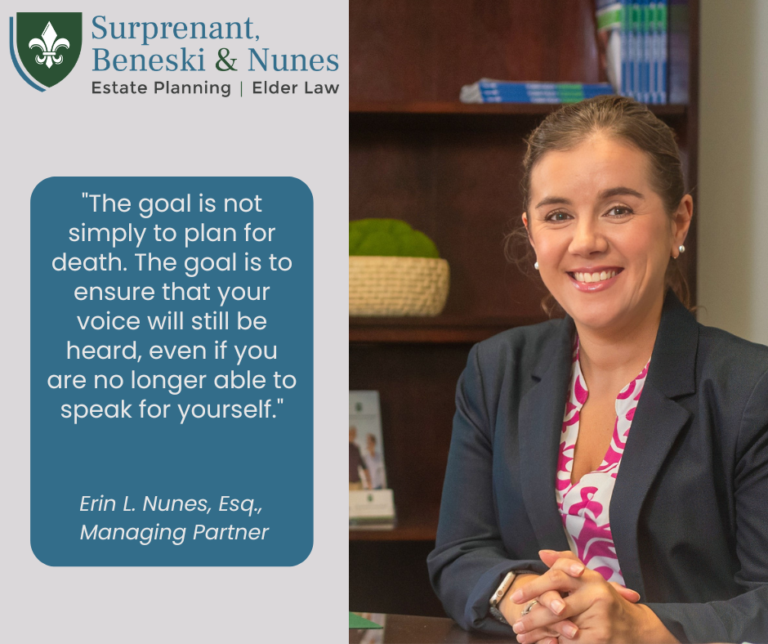
By Erin L. Nunes, Esq.
When people think about estate planning, they often assume that signing legal documents is enough to ensure their wishes will be respected. As an elder law attorney, I can help clients prepare important legal documents such as Health Care Proxies, Powers of Attorney, Trusts, and Wills.
But there is something I cannot do.
I cannot tell you what medical treatments you should want at the end of your life.
Those decisions are deeply personal, medically complex, and best discussed with the physician who understands your health, your prognosis, and your treatment options. The most effective planning happens when legal planning and medical planning work together.
What Your Attorney Does
Your attorney can help you:
- Appoint a Health Care Agent through a Health Care Proxy.
- Authorize access to medical information through a HIPAA Authorization.
- Designate someone to manage finances through a Durable Power of Attorney.
- Create a Trust or Will to manage and distribute assets.
These documents give trusted individuals the legal authority to act on your behalf if you become unable to make decisions yourself. However, they do not answer an equally important question: What decisions would you want those people to make?
That conversation belongs with your doctor—and with the people you’ve designated as your Health Care Agents.
Why End-of-Life Conversations Matter
Many families avoid discussing serious illness, disability, and death. Unfortunately, that often leaves loved ones making difficult decisions during a crisis without knowing what the patient would have wanted.
I’ve seen adult children struggle with questions such as:
- “Would Mom have wanted CPR?”
- “Would Dad want to live on a ventilator?”
- “How much treatment is enough?”
- “When would comfort care become more important than extending life?”
These are not legal questions—they are medical and personal questions. The best time to discuss them is before a health crisis occurs.
Important Documents to Discuss with Your Physician
1. Living Will or Advance Directive
While not legally binding in Massachusetts, a Living Will can provide written guidance regarding your wishes for life-sustaining treatment. These documents are most effective when informed by conversations with your doctor about the realities of serious illness and medical intervention.
2. The Transition from MOLST to POLST in Massachusetts
For years, patients facing serious illness or advanced frailty in Massachusetts have relied on MOLST (Medical Orders for Life-Sustaining Treatment). A MOLST is a actionable medical order—signed by a clinician—that translates your treatment preferences into specific instructions for emergency personnel and medical providers.
However, Massachusetts is currently transitioning from the paper-based MOLST system to the National POLST (Portable Orders for Life-Sustaining Treatment) system, featuring a statewide electronic ePOLST Registry.
Why is Massachusetts making this change?
- Instant, 24/7 Access: Paper MOLST forms are frequently misplaced, lost during facility transfers, or unavailable to First Responders and ER physicians during a crisis. The new ePOLST Registry ensures your medical orders are digitally stored and accessible in real time across the entire care continuum—including EMS, hospitals, and long-term care facilities.
- National Standardization: The National POLST model offers clearer, more granular categories for medical interventions and treatment goals, reducing ambiguity during emergency treatment.
- Portability Across State Lines: Adopting the national POLST framework makes your medical orders far easier to honor if you travel or move out of state.
Note: Existing paper MOLST forms remain valid during this multi-year transition, but future portable orders will be created and stored directly in the electronic registry.
Both MOLST and POLST address critical treatments such as:
- CPR and resuscitation
- Intubation and ventilator support
- Artificial nutrition and hydration
- Hospital transfers and level of medical intervention
Why You Must Include Your Health Care Agent in the Loop
Appointing a Health Care Agent gives someone legal authority but preparing them gives them peace of mind. A Health Care Proxy is only as effective as the clear, honest communication behind it.
When a crisis hits, your Agent isn’t just signing forms—they are stepping into your shoes to speak for you when you cannot. If you haven’t discussed your medical preferences with them, you force them to guess. That burden often leads to guilt, conflict among family members, and second-guessing during already painful moments.
Once you have had these essential medical conversations with your physician, sit down with your primary Health Care Agent and alternate agents:
- Share your specific medical orders: Make sure they understand whether you have signed a Health Care Proxy, Living Will, MOLST, or POLST.
- Explain the “Why”: Explain not just what decisions you made, but why you made them based on your personal values, faith, or quality-of-life boundaries.
- Discuss realistic scenarios: Walk through potential scenarios—such as advanced dementia, severe brain injury, or terminal illness—so they feel confident advocating for your exact preferences.
- Ensure physical and digital access: Ensure your Agent knows where paper copies are stored and that your doctor has entered your orders into your medical record or the state ePOLST registry.
Questions Every Adult Should Ask Their Doctor
Many people do not know where to begin. Consider discussing questions such as:
- About CPR: If my heart stops, what are the realistic chances CPR would be successful for someone of my age and health? If successful, what level of recovery could I realistically expect?
- About Mechanical Ventilation: What does it mean to be placed on a ventilator? If required, how likely is it that I would regain independent function?
- About Feeding Tubes and Artificial Nutrition: What are the benefits and risks in my specific medical situation? Would a feeding tube improve comfort, prolong life, or both?
- About Serious Illness and Dementia: What medical conditions am I most at risk for? If diagnosed with advanced dementia, what decisions might my family need to make on my behalf?
- About Hospice and Palliative Care: When should hospice or palliative care be considered? How do these services focus on comfort and quality of life?
- About Portable Medical Orders: Is a MOLST or POLST appropriate for my current health status, and are my wishes recorded in the state registry and my electronic chart?
The Bottom Line
Estate planning documents provide the legal authority for others to act on your behalf. Your physician helps you understand the medical choices those individuals may someday face.
Both conversations are essential.
If you have signed a Health Care Proxy but have never discussed end-of-life care with your doctor and your designated agents, consider making that appointment today. One thoughtful conversation provides tremendous peace of mind for you, your family, and the people called upon to speak for you.
The goal is not simply to plan for death. The goal is to ensure that your voice will still be heard—and honored—even when you can no longer speak for yourself.
Legal Notice: This content is for educational purposes and should not be construed as legal advice. Every case is unique; please consult with a qualified professional before taking any action based on the information contained in this post. Use of this content does not create a professional-client relationship.